Why Barrington for Brick Making?
Barrington’s brick making legacy spans centuries—and continues to shape the town we know today.
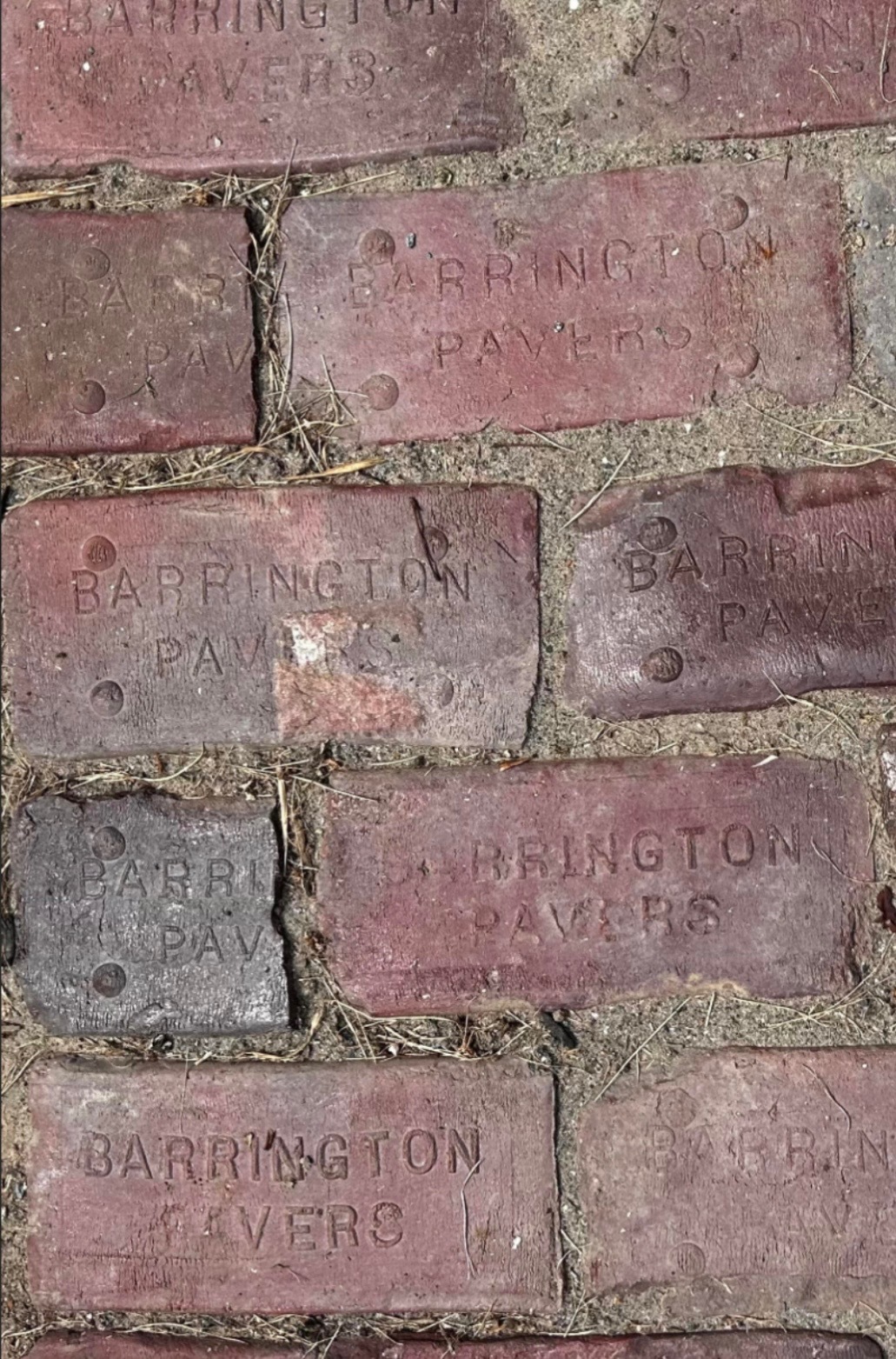
Patio pavers from the Barrington Steam Brick Company.
Do you think our country’s 250 years of existence is significant? Barrington’s brick making history is over 300 years old,
predating the founding of our country! Here our ancestors came upon an abundant supply of the perfect clay for producing
bricks. Matthew Watson, an Irish immigrant, established the first successful brickmaking operation in Barrington around
1720.
His bricks supplied local construction and laid the foundation for an industry that would define our town for generations.
During the industrial revolution, Barrington was a center for brick making. Also, at this time bricks were manufactured initially
by Nayatt Brick Company, established in 1847 which reorganized in 1864 as the Narraganset Brick Company. The New
England Steam Brick Company purchased the Narragansett Brick Company in 1893. The Barrington Steam Brick Company
operated from 1912 to 1943. Twenty million bricks were produced annually among these companies until the operations’
closure, in the mid 1940’s, due to the depleted clay pits.
The various companies that produced bricks relied heavily on the labor of people immigrating to our area. Known particularly
for their craftsmanship in construction, Italians and French Canadians settled in the Barrington area and made a living by
working in the brickyard. These hard workers put in 10 hour days receiving only a $1.00 to $1.25 per day as a wage. Many
descendants of the brick workers still reside in Barrington.
Our historic Town Hall built in 1888 was within walking distance of the Barrington Steam Brick Company. The pavers from this
company were used to build the original jail located in the basement of the town hall. At the rear of the Town Hall is the Clara
Marshall Garden established in 1987 and is in memory of a beloved town clerk who worked at the Barrington Town Hall many
years. Recently, the Hameho Garden Club (HGC) along with the President of the Town Council, Town Manager, and the
Barrington Public Works Director collaborated on widening the old walkways and restoring the patio and bench in the
garden. The town provided the labor, finely crushed stone and the historic bricks that had been preserved.
The bricks from the Barrington Steam Brick Company’s kiln, operating from 1912 to 1943, were used in the newly restored
garden pathway and bench patio of the Clara Marshall Garden. The bricks imprinted with “Barrington Pavers” were used in
this restoration project as it was important to maintain the historic continuity of this very old site. This garden, curated by
HGC includes hardy perennials and shrubs boasting vibrant color and texture throughout each season. Native plants were
added more recently to enhance the Pollinator Pathway aspect of the garden and to contributes to a more resilient and
sustainable environment.
Many town residents including descendants of the immigrants, who worked so tirelessly in the brickyard, enjoy the walkway
and garden. The beautifully restored bench offers visitors a place to relax and appreciate the history of Barrington’s bricks.
This garden restoration allowed for improved accessibility for residents with physical limitations. The civic beautification
team of HGC continues to choose plants and hardscapes based on the current gardening trends and needs in keeping with the
historic nature of this site along with performing ongoing seasonal maintenance.
Hameho Garden Club, established in 1964, is one of the two garden clubs in Barrington. The name of the club is derived from
HA in Hamden, ME in Meadows and HO in Horticulture. Hameho Garden Club is proud to preserve and enhance the beauty
of our historic Barrington Town Hall and Clara Marshall Garden. The restoration and maintenance provide a lasting benefit to
the community as well as honoring the old brick making tradition in our town. Hameho Garden Club was recognized for this
project by the New England Garden Clubs Inc. The club received the Conelia Williamson Watson Award for Historic
Preservation in the Fall of 2025.
References:
Anderson, R.E., Hurst, J.A., Patten, M.F. (1970). Barrington Two Hundred Anniversary. 974.55 BAR. Publisher not disclosed.
Author unknown. (2019) “The story behind Barrington’s magical town hall. Rhode Island Monthly, January 17, 2019.
United States Department of the Interior, National Park Service. National Register of Historic Places Inventory. June 1976.