Way to Go
The move to improve the nation’s roads was mapped out in Newport, before cars
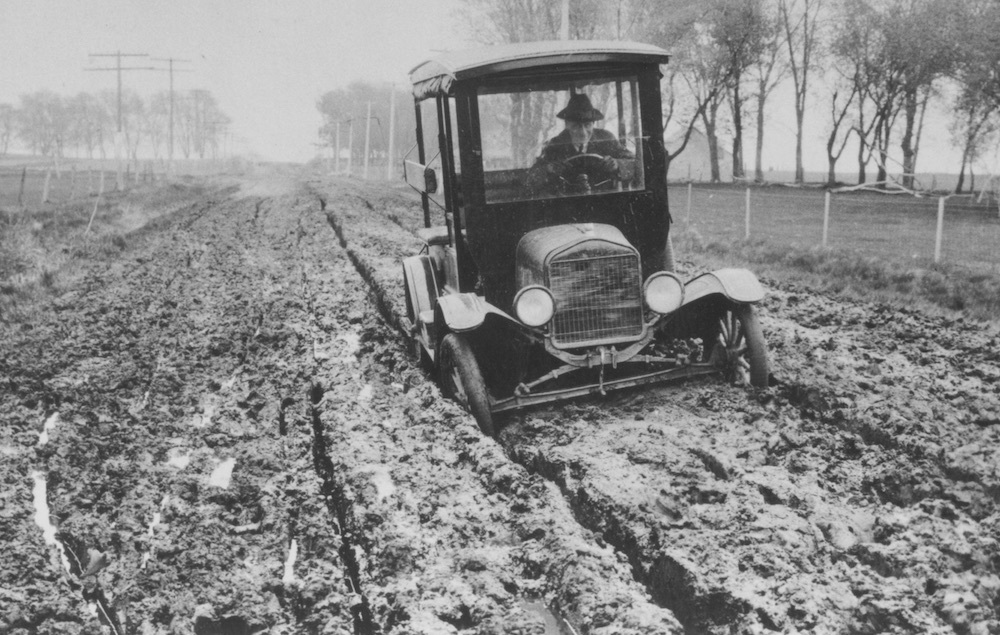
Prior to the Good Road Movement, motoring was often tough going.
Wherever we’d like to go, there’s likely a road to take us there. Not so in 1880, when roads
meandered out from city centers, before dead ending at outlying farms. Trains were the preferred
mode of land travel between cities rather than the only alternative—rutted wagon trails that were
often muddy and impassable
In May of that year, a group of bicycle enthusiasts in Newport founded the League of American
Wheelman to change all that. Capitalizing on the bicycle craze sweeping the country and
drawing support from state and local politicians, national journalists and area farmers, the
League’s efforts took off. Within three years, their publication boasted a million subscribers and
launched the Good Roads Movement nationwide.
Carl Fisher, who opened his own bicycle repair shop at age 17, became an avid automobilist by
age 30. In 1904, he also acquired a shared patent for Prest-O-Light headlamps, which became
standard equipment on every new automobile. Made rich beyond his wildest dreams, he
envisioned something far grander—a road that would stretch clear across the country to be
named after his lifelong hero, Abraham Lincoln. Statues of “The Great Emancipator” would
greet travelers at strategic intervals.
The Lincoln Highway would eventually pass through 12 states and make a virtual beeline across
the country starting in New York’s Times Square and ending in San Francisco’s Lincoln Park.
Though Fisher initially intended for the road to be paid for by leaders in the burgeoning auto
industry, who pledged millions of dollars to get the project started, Henry Ford steered the
financing toward the government instead. Public support was an uphill climb because motoring
was then seen as a luxury for the rich.
Prior to the highway’s creation, a transcontinental auto trip was a daunting 60-day journey, a
safari, where you’d have to carry fuel, food, camping equipment, tools and supplies. In 1913,
only 150 of these treks were even attempted. Ten years later, 20,000 Americans would make the
trip in about 20 days. The many hotels, gas stations and restaurants that popped up along the
route made the thrill of the open road more attainable for less adventurous travelers.
In 1915, etiquette authority Emily Post, then a middle-aged divorcee, embarked on a motor trip
across the country. With pen in hand and her college-age son behind the wheel, she shared many
misadventures of her 27-day lark in Colliers Magazine. She successfully located oases of civility
along the way and enjoyed memorable side trips to Niagara Falls and the Grand Canyon. Her
delicate sensibilities were tested one night, however, when stranded in the desert. Good manners
saw her through the ordeal, without so much as an impolite word being uttered.
Perhaps the most influential person to complete an early cross-country road trip was Dwight D.
Eisenhower in 1919. Part of a massive Army convoy and public relations campaign to drum up
support for better roads, he was then a Lt. Colonel, one of 35 officers who led 80 vehicles on an
arduous, 62-day slog across America. At every turn, The Lincoln Highway proved inadequate to
handle the convoy’s heavy equipment. He was later convinced of the economic and military
benefits of a modern highway system after seeing the German autobahns during World War II,
which inspired him to develop today’s interstate highway system after becoming President in
1956.
With its big box stores and fast-food restaurants, our nearby Route 6 may appear like an ordinary
stretch of today’s American landscape, but it also has a place in American history. Continuing
through 14 states, it is the only road to cross the Hudson, Mississippi, Missouri and Colorado
Rivers. For decades, it held the distinction of being the longest transcontinental road in the
country. Its first section from Provincetown, MA to Brewster, NY was designated in 1925. Later
extended in 1931, it joined up with the Roosevelt Highway in Pennsylvania and adopted its name
for a time. In 1953, the entire route was renamed the Grand Army of the Republic Highway. So,
more than just a home for retail giants, Route 6 serves to honor greatness--Union soldiers who
fought in the Civil War.