Finding Private John Houston
A Revolutionary War Veteran who Should not be Forgotten
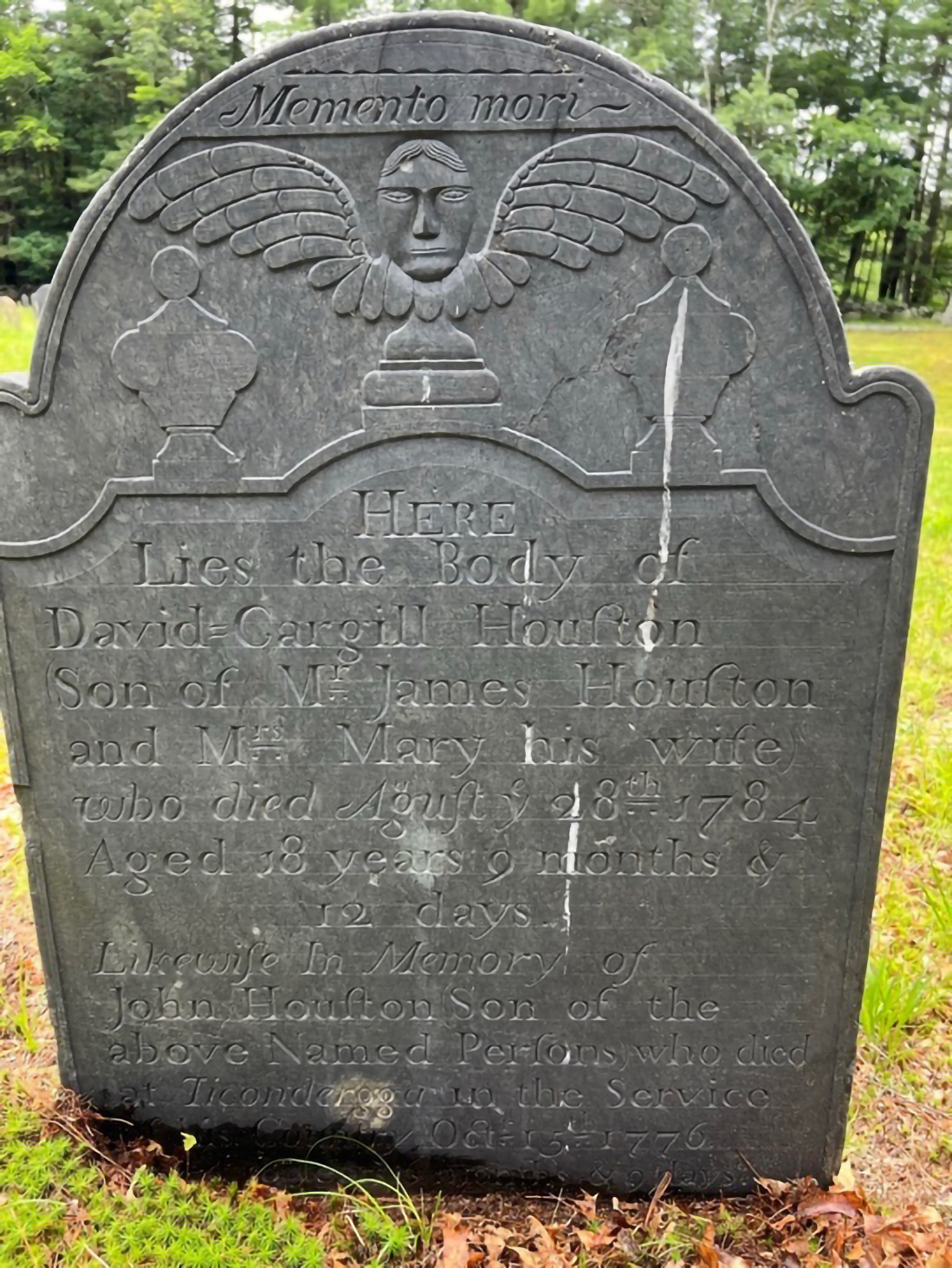
The Bedford Tombstone
In the Old Cemetery of Bedford, near the front entrance, lies a tombstone with the inscription "Here Lies the Body of David Cargill Houfton (Son of Mr James Houfton and Mrs Mary his wife) who died Auguft ye 28th 1784 Aged 18 years 9 months & 12 days. Likewife In Memory of John Houfton (Son of the above Named Perfons) who died at Ticonderoga in the Service of his Country Oct-er 15th 1776 [aged 18 years 6 months] & 9 days" (sic). The cemetery contains the graves of many of the original settlers of Bedford, each with a story to tell. It makes for a meaningful visit if one has a few hours to spare, as I did on the 4th of July, 2023. Each grave marker summarizes the life of a town resident with a few lasting words from family. To see the number of children who died of disease, in some cases the same epidemic taking multiple brothers and sisters, is heartbreaking. Somewhat rarely seen in cemeteries are both head and foot stones marking the graves, separated by 4 ft for children, 5 ft for women, and 6 ft for adult men. The footstones were recently restored as part of an Eagle Scout Project by Oliver Nalenz of Troop 5 in Bedford.
The story of David Cargill Houston is interesting in its own right; a Revolutionary War soldier who enlisted as a private in 1776 at the age of 10 years old… yet it is the epitaph at the bottom that is most intriguing, a reference to an older brother John, who died at Fort Ticonderoga at the age of 18 in October of 1776. A request from a cemetery photographer for more information on John Houston sparked another personal adventure of research by the Bedford Historical Society on the background of this unique family and the impact the founding of our nation had upon them. Upon reading the headstone, a rush of questions came to mind: where was John Houston buried at Ticonderoga? What happened to the Houston family, with two sons passing at the age of 18? What role did the Houston's play in Bedford's early history? Were Revolutionary War records in existence that could shed light on the fate of Private (Pvt) John Houston? Most importantly, why was Pvt John Houston not listed in Bedford's roles of Revolutionary War veterans?
The Houston family was prominent in early Bedford history. The original family consisted of descendants of Samuel Houston (1692-1757) and Mary Ann Cargill (1696-1737), who had at least six children, two of whom, Reverend John Houston (1722-1798) and James Houston (1729-1812), settled in Bedford. Reverend John had a rather contentious career in Bedford that we shall describe shortly; his brother James was the sole Blacksmith in Bedford Center and served as a Private under Col John Stark in the 1st NH Regiment.
Reverend John Houston married Mary Mitchell (1737-1806), and they had at least seven children together. He had a rather contentious, short-lived career as the Presbyterian Minister for the town of Bedford. Not only did he get in a lawsuit with Mathew Patten, but he was also the only adult male in Bedford not to sign the "Declaration of Inhabitants of New Hampshire" issued in Congress on March 14, 1776, showing loyalty to the cause of Freedom. He gave three reasons for refusing to sign: First, that the Committee did not intend for Ministers to take up arms as this was inconsistent with their ministerial charge; second, that he was confined to Hillsborough (as a Preacher) and should be given his liberty before he should sign the obligation, and third, that he already had three family members serving in the Continental Army (two of his sons; Samuel and Robert, served as Corporals in Col Stark's 1st NH Regiment in Capt. Reid's Company.) This refusal to sign would cost him his job as Reverend, and he would never preach again as a minister in Bedford. He was forgiven later in life; however, his actions may have left a mark upon the Houston family.
James Houston, the Blacksmith, shows up in payroll records of August 1775, serving under Col John Stark's 1st NH Regiment and fighting at Bunker Hill. Records show his sons William, Isaac, and David served in the Continental Army as well. David served under Col Stark's 1st New Hampshire Regiment in Capt Reid's Company, while James and William served in Capt Moore's Company. Noticeably absent in any of the Amherst or Bedford records is the mention of James's son, John Houston, whose name appears at the bottom of his brother David's epitaph.
During the Revolutionary War, New Hampshire had three traditional Regiments led by a Colonel: the 1st Regiment under Colonel John Stark, the 2nd Regiment under Colonel Enoch Poor, and the 3rd Regiment under Colonel James Reed. Each Regiment had four to ten Companies, each led by a Captain. Companies were organized at the town level, with each town given an objective of how many soldiers to recruit. Soldiers didn't necessarily have to register in their own towns, and in fact, some of Bedford's citizens enlisted in and were credited to Amherst. Col Stark's 1st Regiment was organized with ten Companies from Hillsborough and Rockingham Counties.
In addition to the three traditional Regiments, there was a smaller 4th non-traditional Regiment, unique in that it was built around soldiers who had been Rangers during the French and Indian War (Vermont's Green Mountain Boys.) Led by Colonel Timothy Bedell (Bedel in some references), the Regiment was organized in Coos county in 1775 with three Companies later expanding to eight, one of which was organized in Amherst and led by Capt Daniel Wilkins (4th Company). Col Bedell's Regiment would meet with tragedy in a place called "The Cedars" in Canada. At least two Bedford residents would serve in the Amherst Company and would not return...
If we look at the date of John Houston's passing and his age, he would have been born in January of 1758, although online records list his date of birth as April 6 or March 26. Based on a single existing pay record from February 1776, John Houston served in Captain Daniel Wilkins's Company in Col Bedel's 3rd Regiment of the NH Militia. In addition, Private Primus Chandler, one of the few black members of the Bedford community, joined Wilkin's Company in Amherst.
As mentioned earlier, this Regiment suffered a serious defeat at the Battle of the Cedars on May 20, 1776, surrendering without putting up a fight. Col Bedel and his second in command, Major Butterfield, were court-martialed for their actions, although Bedel was not physically present during the battle, and later had his court-martial overturned. Nearly 500 members of the Regiment were captured by the British and their allies, the Iroquois. They were mistreated and stripped of their belongings, with Private Chandler being killed. Eight days later, the prisoners were ransomed for release in exchange for a similar number of British POWs, although Congress later refused to honor the agreement. Battling smallpox and hypothermia, the survivors retreated to Fort Ticonderoga and arrived in early June. Capt. Wilkins was one of those captured and succumbed to smallpox in July of 1776; Private John Houston would also die at Fort Ticonderoga, likely of smallpox, on October 15, 1776.
The most likely resting place of John Houston is at the Garrison Cemetery of Fort Ticonderoga. There are very few actual grave markers in the field, only a sign reading, "Here are buried several hundred officers and men of the American Army, chiefly New York, New Jersey and Pennsylvania Militia 1775-77." Curiously, Massachusetts and New Hampshire are not mentioned. It may be that Pvt John Houston was left off the Bedford Rolls because of the notoriety of his Minister Uncle and his association with the Battle of the Cedars. His parents would later leave Bedford entirely. Pvt Primus Chandler is listed as a Revolutionary War Veteran from Bedford despite the fact he enlisted and served in Capt Wilkins Company. He is listed on page 495 of "History of Bedford N.H. 1737-1903" as being "taken at the Cedars and never heard from." He was listed as being "colored" in Amherst records.
The following excerpt is taken from "Rolls of the Soldiers in the Revolutionary War, 1775 to May 1777". Most of the signatories are listed in the payroll records above. Interestingly John was not a signatory, having passed away in October of 1776, his father James however was a signer possibly signing on behalf of his son. This would indicate his son was indeed captured during the Battle of the Cedars. The petition itself was submitted on March 10 1779.
£2-284] [Petition from some of the Sufferers by the Surrender at the Cedars, May 19, 1776.'] To the Honourable the Council and house of Representatives to be conven'd at Exeter, in New Hampshire on this 10th day of March 1779 The Humble Petition and Remonstrance of the Company Commanded by Capt. Daniel Wilkins, in Col° Beedels Regiment in Canada humbly sheweth that on ye May 19 1776, we unhappily fell into the hands of our unnatural and savage Enemy at the Cedars in Canada, when Major Butterfield our commanding officer Capitulated with Capt. Foster of the British army to the great grief and surprise of said Company, on the following terms (viz) that we surrendered ourselves as prisoners of war and was to deliver up our arms which accordingly we did, and we was to have our packs and Baggage — and Capt. Foster Engaged not to suffer the savages to plunder or abuse us, nor suffer the British troops so to do. But contrary to the Rules of War, they inhumanly without regard to their promise, suffered the savages to rob and plunder us of our packs and baggage, and strip us of our clothes off our backs and left us entirely naked, in this deplorable situation we were left in an enemies Country without money clothing or friends that could contribute to our relief — Therefore your humble petitioners humbly pray that your honours would take the matter under your serious consideration and grant to each person a sum something adiquate to the loss he sustained, and your Petitioners will gratefully acknowledge the favour, and as in duty bound shall ever pray (sic)-
Robert Campbell, Hugh McKean, Isaac Curtice John Caldwell, McNeill Laraford, Gilbert John Mills, James Houston, Abot Roby, Lemuel Curtice, Richard Mcallester, John Farnum, Solomon Kittridge, Josiah Warner, Jac Caldwell, Daniel Wilkins, Andrew Wilkins, John Everdon, Joshua Abbot, Aaron Nichols, Obediah Holt, Stephen Cruther, William Bradford, Joseph Lovjoy.
In memory of Private Primus Chandler and Private John Houston, sons of Bedford who gave their lives in the founding of our nation. Let us add their names to Bedford's rolls of hallowed Veterans.