Aladdin Kits in Del Ray
Four surviving Aladdin kit homes on Rosecrest Avenue offer a glimpse into Del Ray’s early suburban growth — and the pioneering woman who oversaw their production
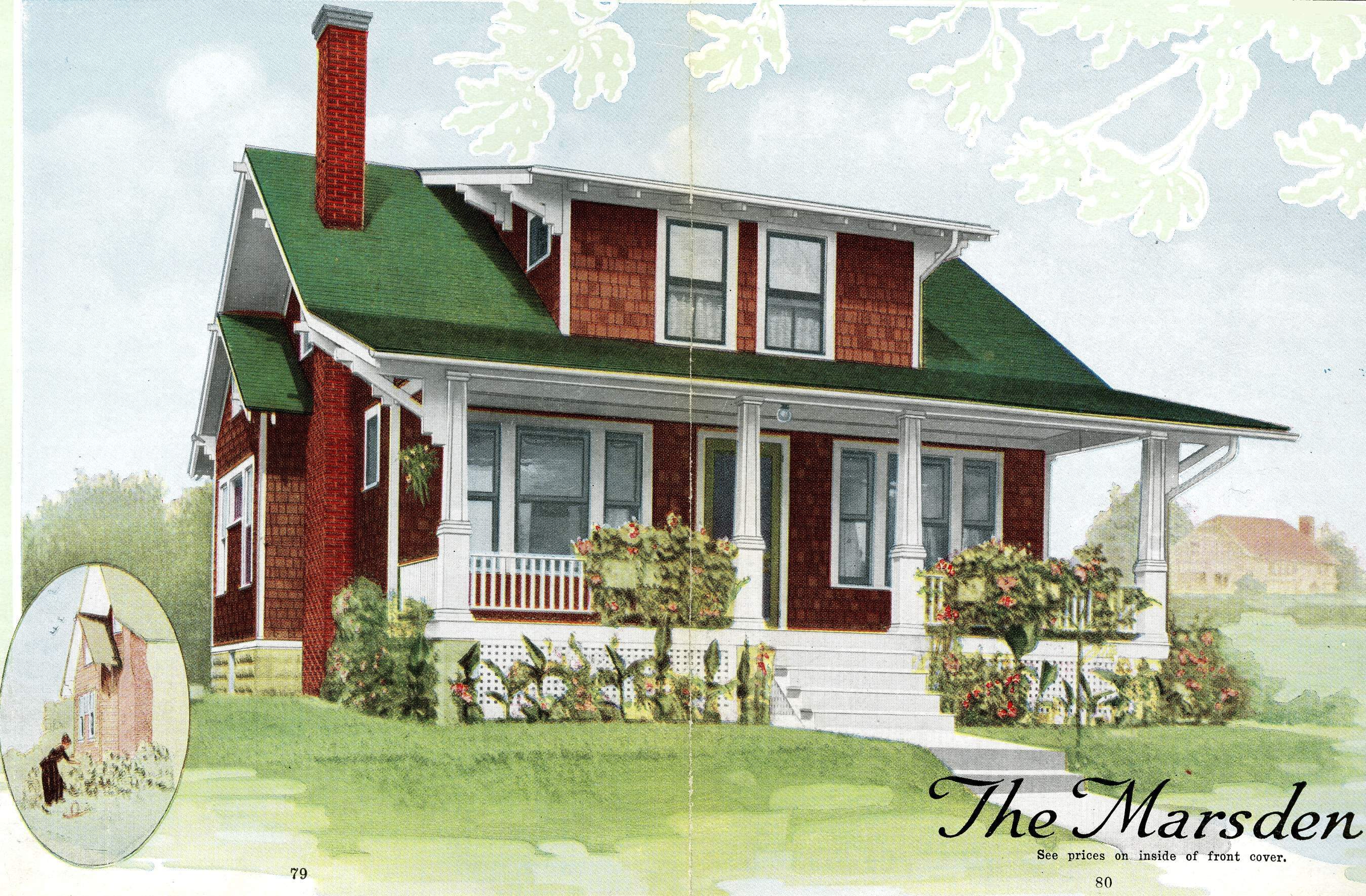
The Marsden model as shown in Aladdin’s 1918 catalog.
Sears vs. Aladdin
Sears is well known for the kit houses it sold from 1908 to 1942. While Sears was, indeed, the largest supplier, with about 100,000 homes sold, close behind it was the Aladdin Co., which sold 70,000 of its own kits. Aladdin started in Bay City, Michigan, but became so swamped with work that in 1921 it established a huge regional manufacturing plant in Wilmington, North Carolina, to serve the Southeast.
The plant was notable not only for its size, with 400 workers, but even more for the fact that it was run by 29-year-old Elsie Lempke, described by several newspapers as the “new champion and feminine captain of industry.” A young woman serving as general manager of a manufacturing operation in 1921 was truly remarkable.
We are lucky to have four of Ms. Lempke’s products here in Del Ray.
In July 1922, the newly formed Rose Crest Corp. submitted the plat for its new development of the same name. It covered the area between Russell Road and Mount Vernon Avenue, bounded on the south by West Windsor Avenue and on the north by both sides of Rose Crest Avenue, now rendered as Rosecrest Avenue. The company divided the property into 58 lots, each averaging 50 feet wide and 120 feet deep.
The Marsden Model
On most of those lots, Rose Crest built homes, sometimes turning to Aladdin for the kits. The company seemed particularly fond of the Marsden model and erected four of them on Rosecrest Avenue, beginning with No. 27 in October 1922, followed by Nos. 19 and 29, and finally No. 31 in July 1923.
The Marsden was a handsome bungalow sided home with cedar shingles and featured a straight-line dormer with exposed eaves, a low-pitched roof and a wood-burning fireplace. Aladdin was notable for incorporating minor design changes to suit customer requests, and the four Marsdens here, all well preserved, show slight differences among them.
For instance, the dormer on No. 31 is slightly wider than the others, while three homes have round pillars and one has rectangular pillars in place of the more ornate versions shown in the catalog.
Next time you need to get to Russell Road, roll up Rosecrest Avenue and offer a salute to Elsie Lempke.