Bringing New Tools to an Old Challenge
It Started at Home
A Moraga native turned his family’s experience with dementia into a platform designed to support both patients and caregivers.
A Moraga native turned his family’s experience with dementia into a platform designed to support both patients and caregivers.
Matt still measures time in trips through Moraga.
He first moved there in 1987, when he was eight, and like a lot of Campolindo grads, the friendships stuck. These days, even with work pulling him in different directions, he’s back most weeks. His parents are still there, and the routine of coming and going hasn’t really changed.
What stands out to him now is the feeling of arriving. Coming through Lafayette or Orinda, the road narrows under a canopy of trees, and the shift is immediate. It feels quieter, without being far removed from everything else.
Matt’s connection to Moraga is steady, but the work he’s doing now began much closer to home.
His mother has been living with dementia since 2018. Over time, he watched how it changed her. Her memory, her mood, and the small day-to-day interactions that once felt effortless. At the same time, he saw what it required from his father, and how the responsibility of caregiving gradually reshaped life for the entire family.
What started as an attempt to make things easier for them turned into something larger. He began to realize how many families were navigating the same situation with very little support.
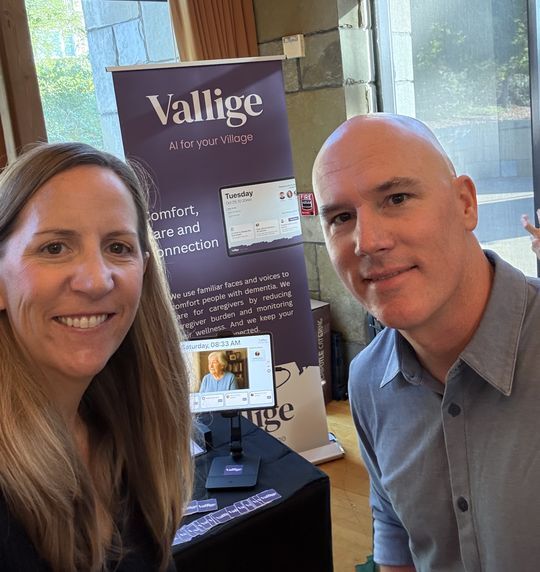
In 2024, he founded Vallige, an AI-powered platform designed to support people living with dementia while also helping the people who care for them. He later brought on co-founder Breck Schubb, another Campolindo graduate, to help expand the vision.
At its core, Vallige is built around a simple idea: helping people maintain a sense of independence for as long as possible, while easing some of the pressure on caregivers.
The platform includes features like Talkstories, which allow individuals with dementia to engage in familiar, steady conversations when family members aren’t available. There’s also Moodshifters, which draw from a person’s life history to create personalized poems, read aloud in a loved one’s voice and paired with photos. The goal is to reinforce recognition and create moments of connection that feel natural rather than clinical.
Alongside those features, Vallige offers tools for caregivers, including care tracking and an AI assistant to help manage the details that come with daily support.
Building the company has been its own challenge. Like most early-stage ventures, it has required persistence and a willingness to keep moving through uncertainty. As Matt puts it, “How do you eat an elephant? One bite at a time.”
What makes it worthwhile are the moments that don’t show up in a product demo. Visiting families, seeing how the platform fits into their routines, and watching small but meaningful shifts in how people feel.
He talks about the reactions simply. How welcoming people are, how emotional those visits can be, and yes, the number of hugs he comes away with.
Living with dementia changes the shape of everyday life, both for the person experiencing it and for those around them. What Vallige offers is not a solution to everything, but it does create space. It gives families a way to stay connected and, at times, step back and catch their breath.
For Matt, that is enough to keep going.