Brent and Erica Poppen
The Measure of a Life is the Lives You Touch
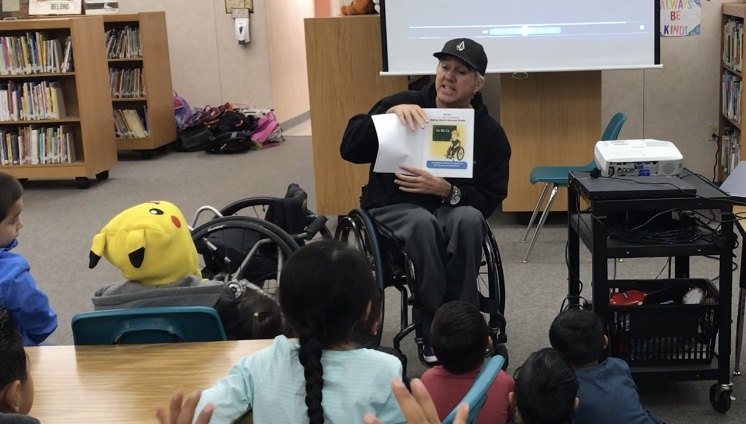
Sharing his book with students
GPR: We have had multiple people nominate you and your wife! What a testimony to how much you guys have given back. You and Erica have called Paso Robles home for quite a while. How did you end up here?
BP: We moved to Paso in January 1999, shortly after we got married in Southern California. My parents had retired to Heritage Ranch several years earlier, and while Erica and I were both in school, we spent time visiting them. We just fell in love with Paso. When Erica finished her teaching credential, I told her I could finish my education anywhere so did she want to teach in Paso or Southern California? The answer came pretty quickly. We decided to start our life here.
GPR: Erica’s career has been remarkably rooted in the community.
BP: She substitute-taught for about two years before getting hired at Kermit King Elementary. She’s never left. She’s been a second-grade teacher for almost her entire career and has been in the same classroom for more than 20 years. I think that says a lot about her passion and the impact she wants to have on kids. One of the special things about Paso is that these relationships don’t end when the school year does. Erica gets invited to high school graduations and even former students’ 21st birthdays. When you live and work in the same community, those kids and families become part of your extended family.
GPR: Your own career has taken a very different but equally meaningful path. Tell us about it.
BP: I was competing in wheelchair rugby and tennis and eventually had opportunities to pursue the Paralympics. I earned my degree from Chapman University while substitute teaching in Paso. I discovered that students responded to my story and experience, and teachers began asking me to come back, not necessarily to teach their lesson plan, but simply to share my life with their students. Eventually, I realized I could reach more kids by speaking on school campuses. That grew organically into the work I do today. I’m also a rehab peer counselor at Valley Children’s Healthcare in Fresno, where I’ve been on staff for 16 years. I get to be the person I wish my family and I had when I was 16 and first went through rehabilitation. I understand what it’s like for a kid to leave the hospital and feel like nobody really understands what their life is going to look like.
GPR: Your injury happened when you were 16. How has that experience shaped the life you’ve built?
BP: I was injured in a wrestling accident at a youth camp at Hume Lake. I sustained a C5-C7 spinal cord injury and was initially paralyzed from the neck down. Because it was an incomplete injury, I eventually regained some function. I don’t look at that day as something that ruined my life. It changed my life. I wouldn’t have met Erica, I wouldn’t have worked at Children’s Hospital, and I wouldn’t have had many of the opportunities I’ve had. I hope someday the person involved in the accident understands that I have an amazing life.
GPR: You and Erica chose not to have children of your own. How did that decision fit into your lives?
BP: It was something we discussed early in our relationship, and we happened to be on the same page. Erica pours so much of herself into her students, and I have the kids I work with at schools and at Children’s Hospital, along with our nieces and nephews. We feel like we’re surrounded by kids we love. It also gives us a little freedom. We can wake up in August, look at each other and say, “Want to go to Mexico?” and get on a plane.
GPR: After 27 years, what do you love most about living in Paso?
BP: Honestly, our backyard. We have been in the same house for all these years. It’s quiet, we have a beautiful view, and we see wildlife all the time. We read, play Mexican Train, Farkle, sit outside and enjoy the peace. That’s what we love about Paso. We chose to live here because we wanted to be part of the community, not just work here. You see your students at the grocery store, the park, concerts and around town. You become part of each other’s lives.
GPR: Looking back, what does Paso Robles mean to you?
BP: It’s home. We’ve been able to build our careers, our friendships and our lives here. Everything hasn’t always gone according to plan, but so much of what has happened has opened doors to things we never could have imagined. We’re grateful we chose Paso all those years ago.