Love That Never Forgot
Honor Flight Kern County honors the past, heals the present, and reminds veterans they still matter.
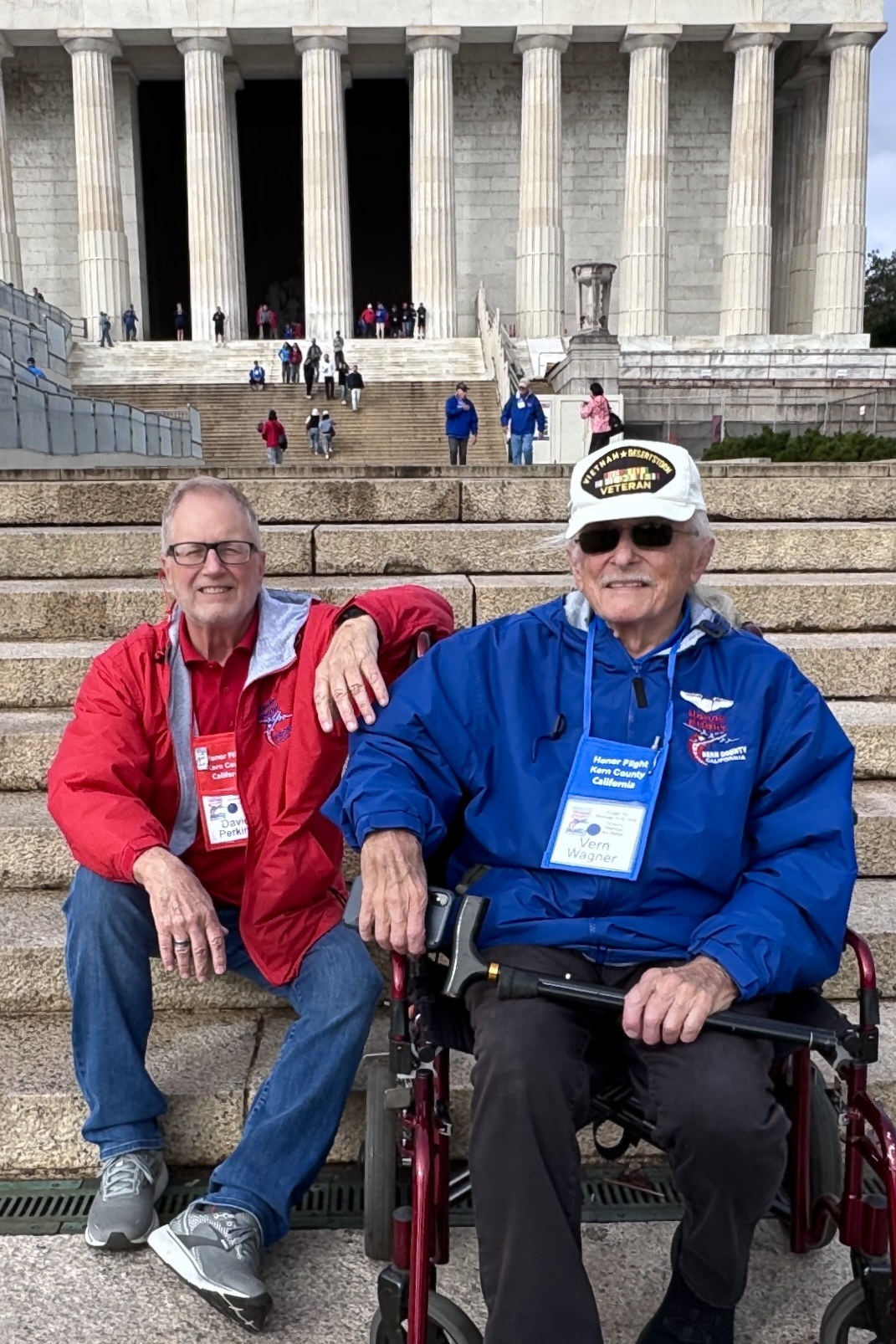
Vern and David, taking a moment at the Lincoln Memorial
Some experiences stay with you long after they’re over. Honor Flight Kern County is one of those. It is part perfectly executed mission, part emotional reckoning, and part long-overdue thank you to men and women who served our country – many of whom came home decades ago to very little recognition.
The Honor Flight Network was co-founded in 2005 by Earl Morse, a physician assistant and retired Air Force captain, and Jeff Miller, a small business owner and son of a World War II veteran. Their idea was simple and powerful: fly America’s veterans to Washington, D.C., free of charge, so they could visit the memorials built in their honor. What began as a way to honor WWII veterans has grown into a national nonprofit serving veterans from World War II, Korea, and Vietnam – giving them the opportunity to reflect, connect, and finally be recognized for the courage and commitment they gave to our nation.
Here in Kern County, Honor Flight took root thanks to Lili Marsh. After watching a 60 Minutes segment about Honor Flight, Lili was inspired by the thought of honoring her own father, a World War II veteran. In 2012, Honor Flight Kern County launched its inaugural flight, sending 20 WWII veterans to Washington, D.C – the first of many missions to come. Sadly, Lili’s father passed away before he was able to make the trip himself, but his legacy lives on through the thousands of veterans who have since flown in his honor.
To date, Honor Flight Kern County has completed 52 flights and served more than 5,000 local veterans. The organization survives entirely through community generosity. One of its most visible champions is friend and longtime radio host Ralph Bailey, who has flown on many trips himself and has raised more than $325,000 over the years from loyal listeners who believe deeply in the mission.
As Lili put it to me, “Bakersfield is a unique community. If people can see, hear, and touch these veterans, it becomes real to them, and they really open their hearts and generosity to this cause. That’s why we fly out of here instead of Los Angeles. Our community wants to be a part of it.”
That community spirit is on full display through the volunteers – because Honor Flight Kern County is run entirely by them. Not one single volunteer is paid. And the word “volunteer” doesn’t quite capture what they do.
The operation would make most military planners proud. Volunteers spend countless hours interviewing veterans and guardians, coordinating travel, arranging hotels, assigning buses, creating name tags and color-coded ribbons, distributing duffle bags and jackets, and ensuring that every breakfast, lunch, and dinner over three full days is covered. The goal is simple: veterans shouldn’t have to think about a single detail. They should just experience the trip.
One of the most common comments I heard – again and again – was amazement at how meticulously organized everything was. Each flight includes a trip captain, bus captains, guardians assigned to care for one or more veterans, media teams documenting the journey, photographers and videographers, and even a two-person medical team making sure everyone stays healthy and comfortable.
My own journey began a few weeks before the trip at the required Meet & Greet. After interviews and selections, veterans and guardians gather to meet for the first time, pick up their gear, and receive a detailed briefing on what to expect. Veterans are issued blue Honor Flight apparel, guardians wear red, and everyone receives a duffle bag and instructions on what to bring – and what not to.
That’s where I met “my” veteran.
I was assigned to Vernon P. Wagner, an 87-year-old Vietnam War veteran, retired Lieutenant Colonel in the United States Air Force. Vern is the kind of man you immediately enjoy talking to – warm, thoughtful, with a quiet sense of humor and plenty of stories from a long life of service.
Vern joined the Air Force in 1966 after completing medical school at Loma Linda University. He served initially as a general medical officer at Tinker Air Force Base in Oklahoma before volunteering to become a flight surgeon. That decision led him to two tours during the Vietnam War in 1968 through 1970, as well as service in Thailand, Korea, Japan, Germany, the United Kingdom, and later Saudi Arabia during Desert Shield and Desert Storm. He retired in 1998 after a 32-year Air Force career.
The “job” of a guardian is simple in theory: help your veteran enjoy the trip. In practice, it means being present – listening, walking together, sharing moments, and sometimes just standing quietly beside them.
Trip day begins early. Very early.
By the time the sun is thinking about coming up, the Bill Thomas Terminal at Meadows Field is already buzzing. Volunteers check in veterans and guardians, hand out seat and bus assignments, and guide everyone through the process. Families arrive to see loved ones off. News crews from local TV and radio stations move through the crowd, microphones in hand. WWII-era nurses are there greeting veterans. Mayor Karen Goh is there – camera and all. Even a Nashville-based barbershop quartet, Mark 209, happened to be in town and serenaded the terminal, sending us off with the National Anthem.
It felt less like an airport and more like a celebration.
Thankfully, Honor Flight uses chartered planes, which means no layovers and no re-boarding chaos. The flight crew volunteers their time as well, and the party atmosphere continues at 30,000 feet. Veterans swap stories. Guardians reconnect from past flights. Laughter flows freely.
Once in Washington, the pace is fast and full. Over three days, we visited memorials honoring World War II, Korea, Vietnam, and multiple branches of the military. At every stop, something remarkable happened: spontaneous applause, handshakes from strangers, quiet “thank you for your service” moments that caught veterans off guard.
At the Vietnam Veterans Memorial, Vern and I searched for the names of three men he served with. When we found them, he placed his hand on each name, shared a brief story, and paused in reflection. There were tears. There was silence. There was respect.
Later, as our bus passed through Arlington National Cemetery on the way to the Changing of the Guard, Vern looked out at the rolling hills filled with white headstones and quietly said, “Just too many.” No further explanation was needed.
On the second evening of our trip, each veteran was formally honored for their years and branches of service, including recognition from Congressman Vince Fong, who presented each of them with an American flag that had flown over the U.S. Capitol. The next day – despite a government shutdown – we were given a private tour of the Capitol and welcomed into the House Chambers by both Congressman Fong and Congressman David Valadao.
But for many veterans, the most emotional moment came at the very end.
When we landed back in Bakersfield, the terminal was filled with hundreds of people – family members, neighbors, ROTC students, cheerleaders, bands, and flag-waving children – cheering, hugging, and welcoming home these deserving veterans. It was a very different reception than many Vietnam veterans experienced decades ago.
At one point during the trip, Vern turned to me and asked, almost quietly, “Did I really do something important?”
Yes, Vern. You did. And thanks to Honor Flight Kern County – and a community that truly shows up – you were finally reminded of it.