Bellevue’s History is Everywhere
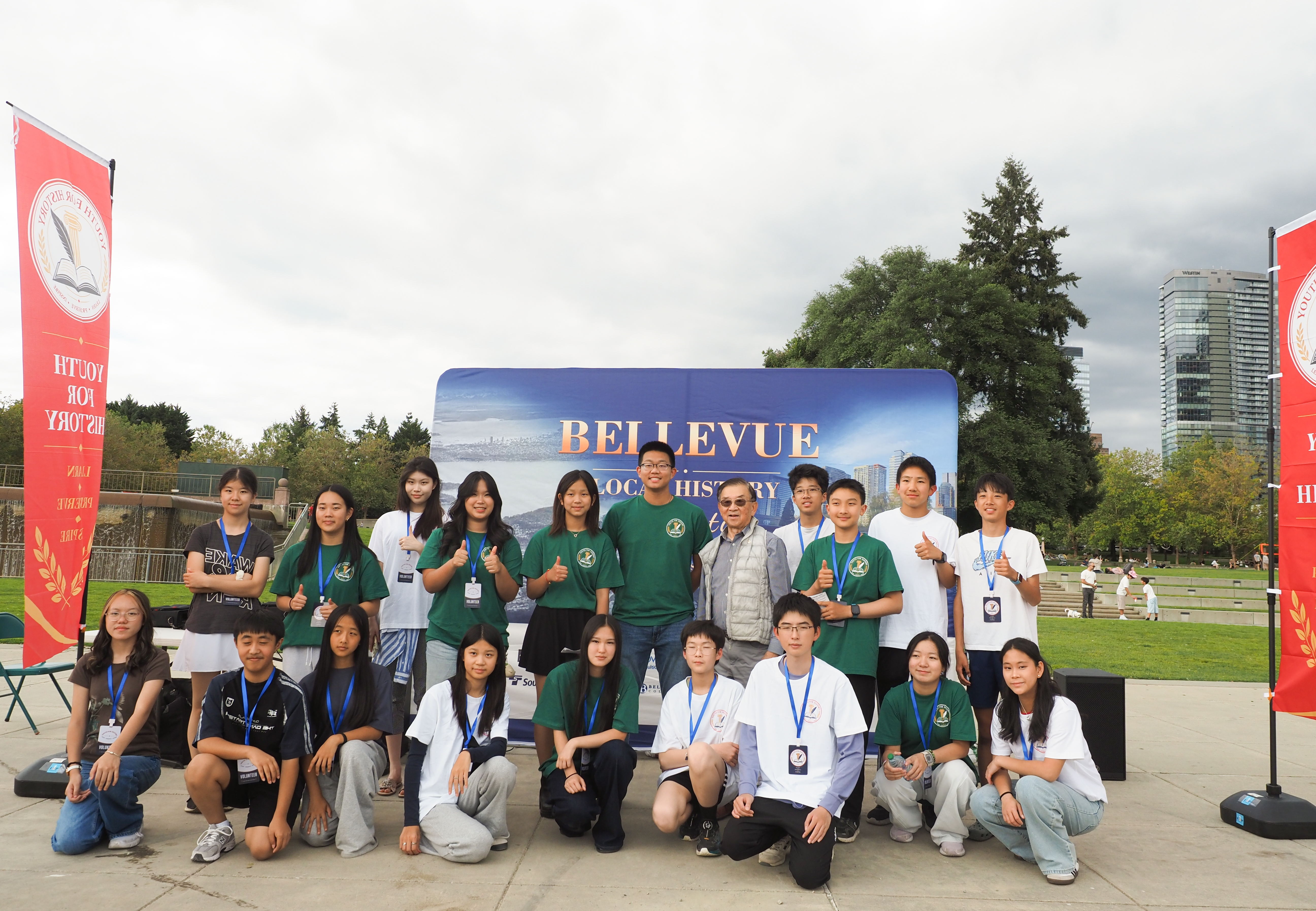
Youth for History volunteers with former Bellevue Mayor and City Councilmember Conrad Lee.
For many young people, history begins far from home. They learn about ancient Rome and Greece, major wars, and famous historical figures, but the stories of the places they pass every day can be harder to find. Richard Hao, Founder and President of Youth for History, wants to change that. The Bellevue-based, youth-led nonprofit was created to help young people discover their communities’ history and understand how those stories continue to shape the places they live.
“I feel like a lot of people in school can talk about so many different historians and historical events, but they can't really talk about what's happening in front of them,” Richard said. Youth for History organizes monthly events and projects that make history more accessible and connected to everyday life. One project includes monthly history boards highlighting events and stories connected to a particular month, while placing local history alongside larger events in U.S. and world history.
For Richard, some of the most interesting discoveries are the small stories that might otherwise go unnoticed. He points to the Bellevue Library, which began in 1925 when the Bellevue Women’s Club opened a small library in the back of a Main Street café. The library moved several times before settling into its current home. “These small anecdotes around the community, I think, are really interesting for everyone to learn,” Richard said.
That spirit of discovery was at the center of the Bellevue Local History Celebration back in August, at Bellevue Downtown Park. The free event brought together City of Bellevue departments, historical organizations, schools, libraries, and community groups, giving residents a chance to learn about Bellevue’s past and how the city has changed.
Participating organizations included Eastside Heritage Center, the Puget Sound Branch of the Washington State Archives, King County Library System, Bellevue School District Welcome Center, Emerald Parents Association, Overlake Medical Center & Clinics, Bellevue Farmers Market, Visit Bellevue Washington, Bellevue College, Primrose School of West Bellevue, and Sound Transit. Several City departments also participated, including Bellevue Police, Community Development, Development Services, Utilities, and Kelsey Creek Farm.
Richard hopes that by bringing these organizations together, residents will have a more complete picture of Bellevue’s history. “It’s kind of difficult to really have a picture of Bellevue’s history by just knowing a few events,” he said. “If you bring together so many of the organizations that have had such a big impact on Bellevue’s history, we can better illustrate to the community how we’ve grown as a whole.”
Some stories are lighthearted. Richard points to Bellevue’s early police station, which was partially underground. When it rained, salamanders reportedly found their way inside. Other stories are more difficult. Before Bellevue became known for its skyline and technology industry, much of what is now downtown was farmland and home to Japanese American families. Strawberry farms once covered more than 100 acres across Bellevue. During World War II, roughly 60 Japanese American families were forced to leave their homes and farms, and many never returned. For Richard, understanding that history is essential to understanding modern Bellevue.
“These are stories that we need to acknowledge,” he said. “We need to be aware of these things because of the impact they’ve had and how our city has grown and changed as a result.” Today, Bellevue’s transformation is visible in its skyscrapers, technology companies, light rail, and expanding infrastructure. But Youth for History hopes residents will remember the generations of stories that came before the modern city. “Knowing your history has really important implications for how you move forward,” Richard said.
That philosophy has continued beyond the August celebration. Youth for History is also organizing a statewide local history writing contest for grades 5-12 as part of its work with Washington State America’s 250th, encouraging students to research their communities and write about what they discover. For students interested in getting involved, Richard’s advice is simple: start asking questions. Local historical societies, libraries, museums, parks, and neighborhood signs can all provide starting points. “History is honestly everywhere around you,” he said. “And ask questions. Questions are really important. You can find out a lot by just asking a single question, like, 'Why?'”
Ultimately, Youth for History is about more than memorizing dates or names. Richard wants young people to see themselves as part of their communities’ stories and help preserve those stories for the future. “I think the main goal of this whole organization is just to have more students and people in general engage with their local history and know about their community,” Richard said.
While Bellevue is the organization’s current focus, Richard hopes the idea will eventually reach communities far beyond the Eastside. “Local history is something everyone around the world should know about,” he concludes.