More Than a Robot
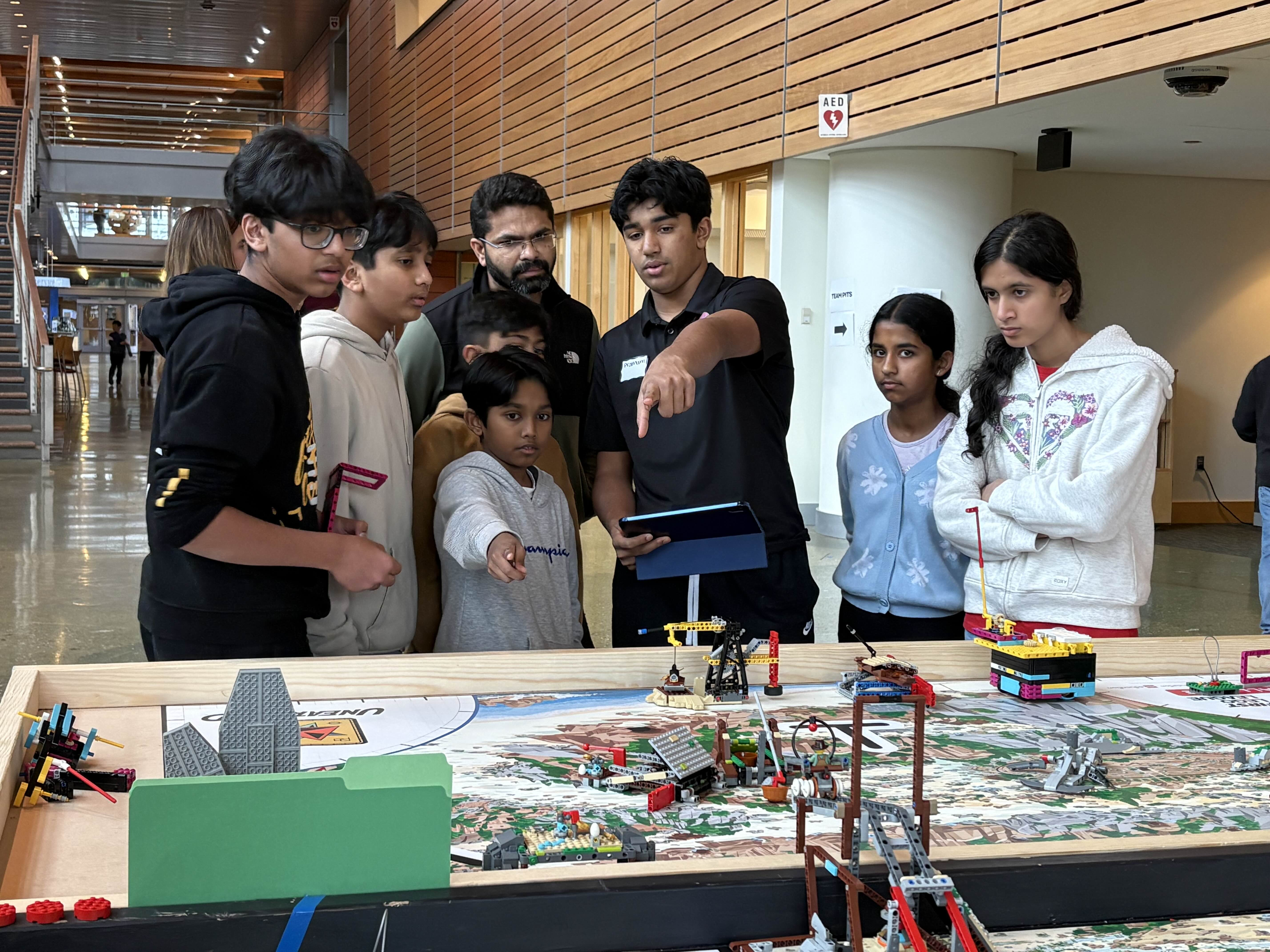
Inside Bellevue City Hall, the sound of gears mixed with conversation as students huddled around laptops, tested robots and waited for match scores. Some robots used hooks, others scoops or claws, each designed to tackle the same challenge in a different way. And when something didn’t work—as is often the case in robotics—students headed back to make adjustments and try again.
That was the scene at High Definition Robothon, a free community robotics competition hosted by FTC Team 18225 High Definition, a Bellevue-based team of students in grades 7–12.
Fourteen teams participated, engineering robots to pick up blocks of different shapes and move them to designated locations for points. But for High Definition, a six-time FIRST Tech Challenge World Championship qualifying team, the competition itself was only part of the story.
Before Robothon, team members hosted workshops to help students with little or no robotics experience build their own robots. During the event, they worked alongside participants, answering questions and troubleshooting problems so students at different skill levels could experience the excitement—and inevitable frustrations—of building something themselves.
High Definition team member Elaine knows how powerful that first introduction to robotics can be.
She discovered the team while attending a summer robotics camp at the University of Washington, when High Definition members visited her class to demonstrate their robot. With little robotics experience herself, Elaine was impressed enough to step outside her comfort zone and join.
Later, while helping organize a free LEGO robotics workshop, she found herself on the other side of that experience. A young girl approached Elaine and asked how she could keep doing robotics because she was having so much fun.
“Being able to inspire someone else like that felt like a full-circle moment,” Elaine says.
That opportunity to spark an interest in younger students has become an important part of High Definition. Beyond Robothon, members manage several local robotics clubs and volunteer with younger students throughout the community, including programs designed to make STEM more accessible.
But before they could teach others how to work through the challenges of robotics, team members had to learn to do it themselves.
Building a competition robot, they say, is rarely a straightforward process. A robot can go through dozens of small changes—and sometimes fixing one thing unexpectedly creates another problem.
Pratham, another team member, remembers discovering that a set screw was missing from a servo controlling the angle of the team’s shooter. Adding it seemed like an obvious fix. Instead, the change affected the robot’s tuning, caused programming issues and eventually left it unable to score.
“Once it’s working, even the smallest changes can disrupt it,” he says.
Those experiences have taught the students that robotics requires far more than technical ability. It takes patience, problem-solving and a willingness to keep going when the solution isn’t obvious.
Sometimes it also requires very long nights.
During one competition season, the team decided to pursue an ambitious redesign with little time to complete it. With another competition approaching, they began to question whether the new robot would be ready. After simplifying the design, the mechanical team worked together through the night.
They finished what team member Calvin describes as their best robot yet.
It is those behind-the-scenes moments that make the victories especially meaningful.
Team member Neel still remembers qualifying for the World Championship during his first year with High Definition. New to FIRST Tech Challenge at the time, he didn’t initially understand how significant the accomplishment was. What stayed with him was seeing all of the team’s work come together—and realizing how invested everyone was in reaching the same goal.
The students say that is something spectators may not fully see when they watch a robotics competition. Behind an award or successful match are redesigns, programming problems, disagreements, late nights and countless attempts at figuring out why something that worked yesterday suddenly doesn’t work today.
Yet competition has also taught them something unexpected: the teams they compete against are often the same people willing to help when things go wrong.
Team member Nick says competitors regularly lend each other parts when something breaks. Others point to the friendships they have formed and the culture of “Gracious Professionalism” within FIRST—competing hard while still supporting one another.
That same spirit filled City Hall during Robothon. When robots malfunctioned, students returned to their workstations to adjust code or mechanisms before trying again. High Definition members circulated among the teams, helping newcomers troubleshoot and encouraging them through the process.
For the students who have spent years experiencing those highs and lows themselves, Robothon was an opportunity to give someone else a place to start.
The robots may have brought everyone together, but what High Definition hopes students took home was something bigger: the confidence to experiment, solve problems, help one another and, when something inevitably goes sideways, try again.